Smart People Are Refusing to Use AI. It's Costing Companies Millions.
What I learned from a Christmas dinner conversation that changed how I'll attack AI adoption on my team.

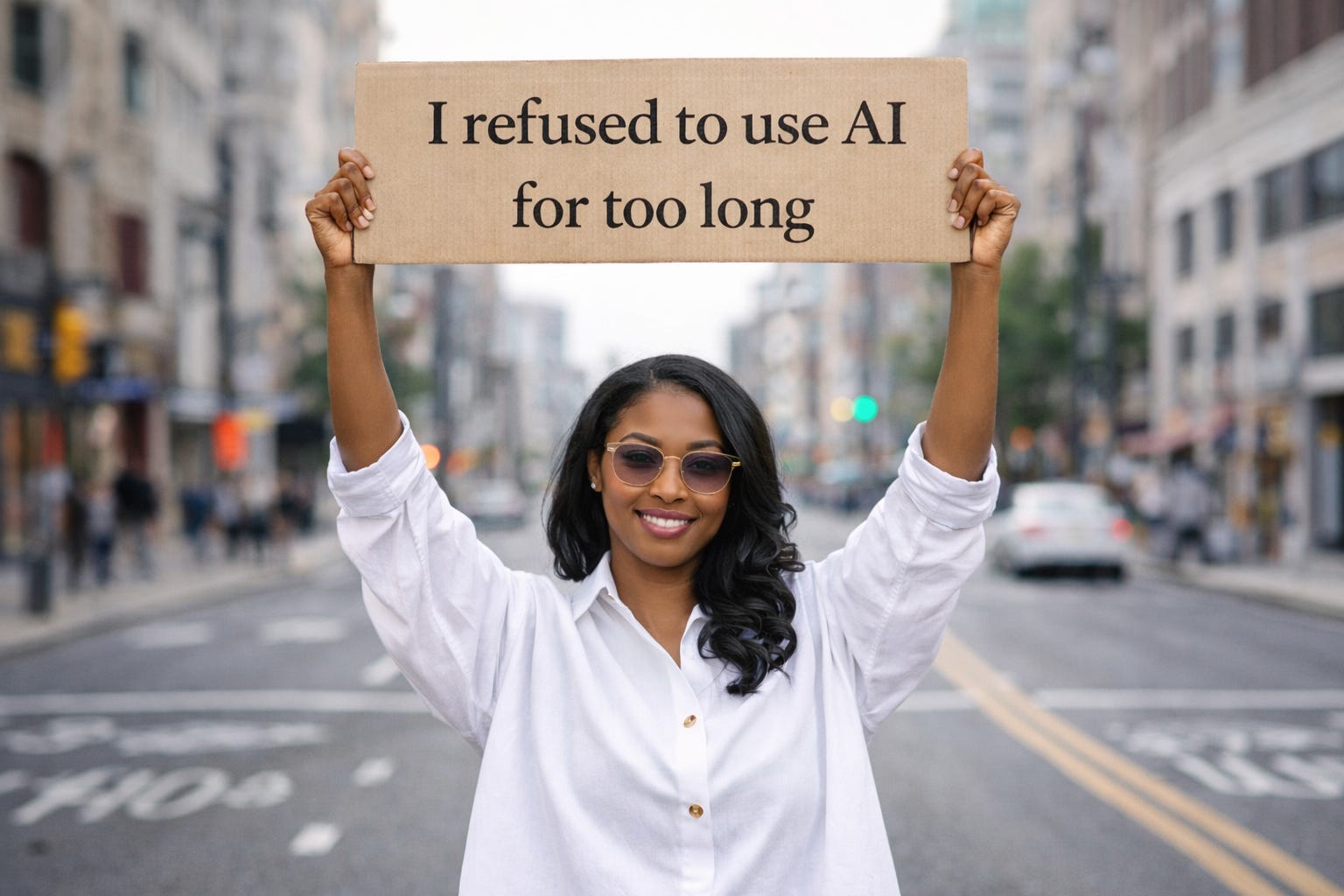
Over Christmas dinner, the conversation turned to work, careers, and a few upcoming college grads in the family. Someone asked whether AI was going to impact their job hunting, and suddenly there was an opening.
So I asked a simple question:
Who’s using AI?
What surprised me wasn’t those concern about AI. It was how few people had even tried it.
This wasn’t a room of people disconnected from technology. Around the table were highly educated professionals. A 25-year IT veteran. A recent attorney. A nurse. A marketing exec. People who are smart, capable, and deeply experienced in their fields.
And almost none of them were using AI.
Not because they couldn’t figure it out. Because they didn’t trust it.
The Adoption Problem No One’s Talking About
Here’s what most companies are getting wrong about AI rollout:
They’re treating it like a training problem when it’s actually a trust problem.
The playbook looks like this:
Send everyone to a lunch-and-learn about ChatGPT
Share a list of “AI tools you should try”
Send top-down mandates: “We need to integrate AI into our workflows”
Wait for adoption
Then six months later, usage is still low. Leadership assumes people “just don’t get it” or “aren’t technical enough.”
But that’s not what’s happening.
People understand AI is powerful. They’re just not convinced it won’t make them obsolete.
One conversation at that Christmas dinner made this crystal clear.
The 25-Year IT Veteran Who Refused to Touch AI
My aunt has spent over 25 years in IT. She’s not intimidated by technology. She’s built systems, managed infrastructure, worked with code.
But she told me she hasn’t embraced AI because she feels like she’d be training it to replace her. Or worse, teaching it how to steal her job.
I understood the fear. It’s valid.
Her resistance wasn’t about capability. It was about psychological safety.
She didn’t need more tutorials. She didn’t need someone to explain what AI could do.
She needed to see that AI wouldn’t erase her value, it would amplify it.
What Actually Changed Her Mind
Instead of debating the future of work, I shifted the conversation.
I asked her one question: What’s something you do regularly at work that’s repetitive?
Her answer: Creating brokerage statements. She uses design software to build these reports manually. It’s not hard, but it’s time-consuming and repetitive.
I pulled out my phone and opened Canva’s AI Code tool.
I entered a basic request: “I want to create a brokerage statement. Add a bar chart for the summary section.”
Canva started building it immediately. The first version was basic, so I asked ChatGPT to help me refine the request with more specific details about what a professional brokerage statement should include. I took that expanded prompt and fed it back into Canva.
The output came back in seconds.
But what stopped her in her tracks wasn’t the speed.
It was watching the code appear on the screen in real time.
She leaned in, reading line by line.
It looked familiar. Structured. Like what she’s worked with for years.
This wasn’t AI doing something mysterious behind the scenes. It was generating something she could recognize, review, and refine.
You could see the shift happen. The moment it stopped feeling like a threat and started feeling like a tool.
The Insight That Changes Everything
Here’s what I realized watching her reaction:
AI adoption isn’t about demonstrating capability. It’s about demonstrating control.
People won’t use AI until they can see:
Their expertise is still the most valuable part (AI gives structure, they add judgment)
The output is something they recognize (not a black box doing magic)
They can verify and refine it (they’re still in control)
My aunt didn’t suddenly “get” AI. She saw that AI could handle the repetitive structure-building while she remained the expert on what the statement should say, how the data should be presented, and what her clients needed.
AI didn’t replace her. It gave her leverage.
What Leaders Are Getting Wrong
Most AI rollouts fail because they focus on the wrong things:
What companies do:
“Here’s what AI can do” (capability demos)
“You need to learn this or fall behind” (fear-based pressure)
“AI will make us more efficient” (productivity pitch)
What actually works:
“Here’s how AI preserves your expertise while handling the repetitive parts” (trust-building)
“Watch it generate something you already recognize” (demonstration of control)
“Your judgment is what makes this valuable” (reinforcement of their role)
The difference is massive.
One approach says: “Adapt or get left behind.”
The other says: “Here’s how this makes you more valuable.”
Guess which one gets adoption?
The Hidden Cost of Failed AI Adoption
Here’s what this resistance is actually costing companies:
Productivity loss:
Teams spend 10-15 hours/week on repetitive tasks that AI could handle in minutes. Multiply that across a 50-person team, and you’re looking at 500-750 hours of wasted labor per week.
At an average salary of $75K/year (roughly $36/hour), that’s $18K-27K/week or $936K-1.4M/year in labor costs on work that could be automated.
Competitive disadvantage:
While some teams resists AI, competitors who figured out adoption are operating 2-3x faster.
They’re shipping more, iterating quicker, and doing it with 30-40% fewer people. The gap compounds weekly.
Talent drain:
The best people burn out doing repetitive work that feels beneath their skill level. Replacing a skilled employee costs 1.5-2x their annual salary in recruiting, onboarding, and lost productivity.
If a company loses 3-5 key people/year because they’re stuck in busywork, that’s $225K-750K in turnover costs alone.
Opportunity cost:
But the biggest cost isn’t measured in dollars or hours. It’s the opportunity cost of not building leverage when the infrastructure is finally accessible.
For the first time in history, a solo operator can compete with a team of 10. A small business can move like an enterprise. But only if they actually use the tools.
The companies hemorrhaging millions right now aren’t the ones without AI tools. They’re the ones who rolled out AI but can’t get their people to use it.
Similar to the solopreneur that’s struggling to get it all done but doesn’t have a ChatGPT account.
The Pattern That Actually Drives Adoption
If you’re trying to get your team, your company, or even yourself to use AI more effectively, here’s the pattern:
Step 1: Start with recognition, not revolution
Don’t show them something AI-generated that looks impressive but unfamiliar.
Show them AI generating something they already make (emails they write, reports they format, processes they follow.)
When they see AI produce something they recognize, it stops being magic and starts being infrastructure.
Step 2: Position AI as augmentation, not automation
The framing matters.
“AI can do this for you” → feels like replacement
“AI can handle the structure so you focus on the judgment” → feels like leverage
People protect their expertise. Show them AI enhances it instead of threatening it.
Step 3: Let them control the output
Give them the ability to review, edit, and refine.
The moment someone can adjust AI’s output with their expertise, they realize: “Oh, I’m still the expert. AI just gave me a head start.”
That’s when resistance turns into adoption.
What I Learned From That Conversation
I talk about AI constantly. I use it every day to run multiple businesses, manage teams, create content, build systems.
But that Christmas dinner reminded me: most people aren’t where I am.
They’re not thinking about custom GPTs or automation pipelines or AI agents.
They’re thinking: “Will this help me or replace me? Can I trust it? Do I have time to figure this out?”
And the answer depends entirely on how it’s introduced.
If you show someone AI generating something unfamiliar, it feels like a threat.
If you show them AI generating something they recognize and can improve, it feels like a tool.
That’s the difference between resistance and adoption.
The companies and entrepreneurs that win with AI won’t be the ones with the best tools. They’ll be the ones who figured out how to make themselves and their people trust it.
Subscribe to get my weekly breakdown of the systems I’m building, the experiments I’m running, and the lessons I’m learning about using AI as leverage—not replacement.
Gerrie, this is 🔥. So true. Companies don't explain and fully educate before implementation.